Articles
The Language of Your Prompt Decides Which Parallel Universe of Training Data You Are Talking To
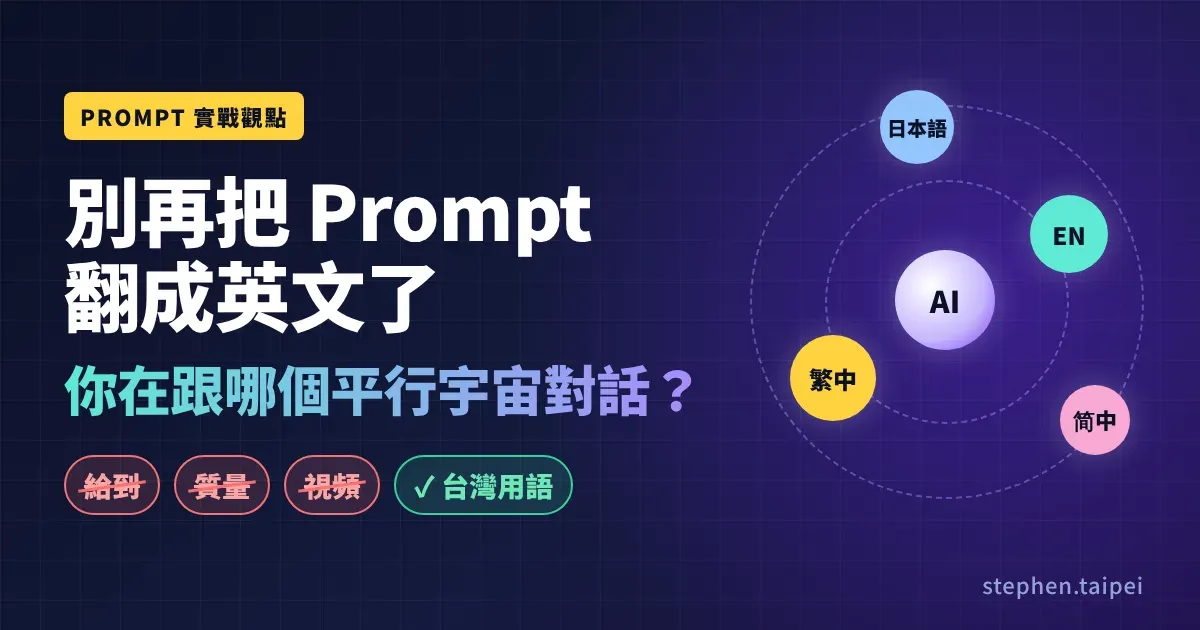
Stop translating your Prompt into English to save Token! Why does the more you translate into English, the more the AI answers with "給到" and "質量"? Drawing on ACL language model research and hands-on experience, this article explains why "technical terms in the original + native-language description + explicit regional anchors" is the best way to cut the cost of back-and-forth corrections.
· 8 min read
Stop Translating Your Prompt into English: Why the More You Try to Save Token, the More the AI Answers with "給到" and "質量"?
TL;DR (Key Takeaway)
The best-practice formula for writing a Prompt is: "keep technical terms in the original English + write the context in the native language of your target audience + explicitly tie it to a region and audience anchor". This does not guarantee the most idiomatic text every time, but it greatly raises the odds of getting it right on the first try and saves the friction of repeatedly fixing tone and wording.
Many engineers and heavy AI users share a habit: to save a bit of Token, or because they heard that "AI reasons better when you ask in English", they run their request through a translation tool before sending the Prompt, then tack on Please reply in Traditional Chinese at the end.
The result? You saved a few cents of Token, but got a whole page of "這個方案能給到你很好的體驗" and "如何優化代碼質量". Then you spend 10 minutes manually changing those words back to the usage common in Taiwan.
The language you ask in decides which group of people's corpus the AI draws its answer from.
1. A Real Pitfall: Why Does the AI Keep Writing "給到"?#
A while ago I asked an AI to put together an information summary, with the output in Traditional Chinese. The logic of what it produced was fine, but it contained sentence patterns like "給到…".
"給到" is typical mainland China workplace jargon, and people in Taiwan almost never say it in everyday communication.
The problem is not that the AI does not understand Chinese, but that "language is not region, and Traditional Chinese is not Taiwan".
In the training corpora of large language models (LLMs), there is far more Simplified Chinese data than Traditional Chinese data. When you give instructions only in English and ask for Traditional Chinese, the model easily falls back on the Chinese wording with the most data (mostly from mainland China) and simply outputs it in Traditional characters.
Writing the Prompt in your native language only nudges the AI toward localization; spelling out the "region" and the "audience" is what closes the last gap in context.
2. Why Does the Language You Ask In Directly Change the AI's Answer?#
This is not mysticism. It is the inevitable result of how language models work underneath. From a technical and research point of view, there are three core reasons:
1. The AI is built on "conditional probability and next-token prediction"#
On the same topic, people from different language communities naturally have very different angles, idioms and values. All of these differences are compressed into the weights of the training data. When you ask in English, the model continues along the English-language corpus; when you ask with the Traditional Chinese vocabulary used in Taiwan, it is more likely to land on the probability distribution of the Taiwan context.
2. Academic research confirms it: the language you ask in triggers the corresponding Cultural Alignment#
A study published at ACL in 2024 (AlKhamissi et al., 2024, arXiv:2402.13231) simulated social surveys of Egypt and the United States. The team found that when asked in the dominant language of a culture, an LLM's answer distribution is significantly closer to the real survey results of people there. The study also found that the less represented a group is and the more sensitive the topic, the larger the model's bias.
3. Your language and word choice are the main clues the AI uses to judge "who you are"#
The AI does not know you. When no complex personal Memory is loaded, the language you use, the technical terms you mix in, even your punctuation habits are all implicit clues the model uses to infer the "asker's background" and the "expected level of output".
3. Not Just Language: "Tone" Is Part of the Prompt Too#
Besides choosing the right language, the "level of politeness" you show in your native language also affects how the model performs.
Another cross-lingual study on English, Chinese and Japanese Prompts (Yin et al., 2024, arXiv:2402.14531) found that being too rude or impolite to an AI usually lowers the quality of generation, but being overly courteous or roundabout does not guarantee better performance either. More importantly, every language has its own "optimal politeness level (Sweet Spot)", the golden balance that is just right, and it differs from language to language.
Writing in the native language you know best lets you control the tone precisely (for example: "direct tone, no marketing fluff") and avoids losing control over tone and style in stiff English translations.
4. Chinese vs. English Prompt Decision Matrix (When Should You Use English?)#
Stressing the importance of your native language does not mean giving up English entirely.
Now that Input Token is extremely cheap, "saving Token" has long been a false issue, and the real cost is the friction of back-and-forth communication and manual edits. What matters is not Chinese versus English, but whether what you want right now is "localized context" or "pure technical correctness".
You can use this decision table directly:
| Task scenario |
Recommended language |
Core reason and strategy |
| Localized content production (blogs, marketing copy, product UI copy, customer emails) |
Native-language description + English terms + regional anchors |
Avoids translationese and non-Taiwan usage (e.g. 視頻, 質量, 給到) and goes straight to the Taiwan audience's context. |
| Cross-border multilingual translation (e.g. Chinese to Thai, localizing a multilingual website) |
Native-language instructions + explicitly specified target region and role |
Avoids the double loss of meaning caused by going through English as a Pivot Language. |
| Pure code generation and Debug (system architecture, algorithms, troubleshooting) |
Either Chinese or English (recommended: logic in native language + English terms and Error Log) |
Technical keywords (API, PR, Deployment) and official documentation are in English to begin with, so keeping the original aligns with the most accurate technical weights. |
| Looking up the latest overseas technical docs / academic papers |
Mostly English |
The original material is mostly in English, so searching directly with English keywords (RAG / Search) gives the highest recall. |
5. Practical Checklist: 5 Checkpoints for Getting a Precise Response in One Shot#
Next time you write a Prompt that needs high-quality Chinese output, stop opening the translation tool. Just apply this list:
Practical Prompt Comparison#
❌ Wrong example (blind faith in English + vague conditions):
Write a blog post about prompt language selection in Traditional Chinese. Make it professional.

✅ Right example (native-language context + terms in the original + region and audience anchors):
Using the Traditional Chinese commonly used in Taiwan, write a technical opinion article for engineers in Taiwan, on the topic "Choosing the language of your Prompt".
Requirements:
1. Keep technical terms (such as Token, Prompt, Context, API) in the original English; do not deliberately translate them.
2. Direct, objective tone; give conclusions and an actionable list straight away, with no textbook tone or marketing fluff.
3. Strictly use Taiwan local wording and avoid words such as "給到, 質量, 視頻, 代碼".
Frequently Asked Questions (FAQ)#
Q1: Does writing a Prompt in Chinese use more Token and run slower?#
The same content written in Chinese usually has somewhat more Token than in English, but Input Token is priced extremely low. Compared with the little Token cost you save, the time wasted on "regenerating" or manually rewriting because of the wrong context is the most expensive hidden cost.
Q2: Why does the AI still produce mainland China wording even though I already asked it to use "Traditional Chinese"?#
Because to the model, Traditional Chinese often only means "character encoding and glyphs (Script)", not "regional culture (Locale)". Hong Kong and Macau Chinese, Taiwan Chinese and text converted from Simplified to Traditional all count as Traditional Chinese. You must explicitly specify "Taiwan wording (zh-TW)" and "target audience (e.g. engineers in Taiwan)" to properly narrow the model's word choices.
If you want a localized answer, ask in the local language, then spell out the region.
This logic applies not only to everyday Q&A but is also the core foundation of localizing products across countries. In the next article, we will take this concept straight into real engineering work: "When a website supports 22 locales, how do you get AI to automatically produce truly idiomatic localized translations?"